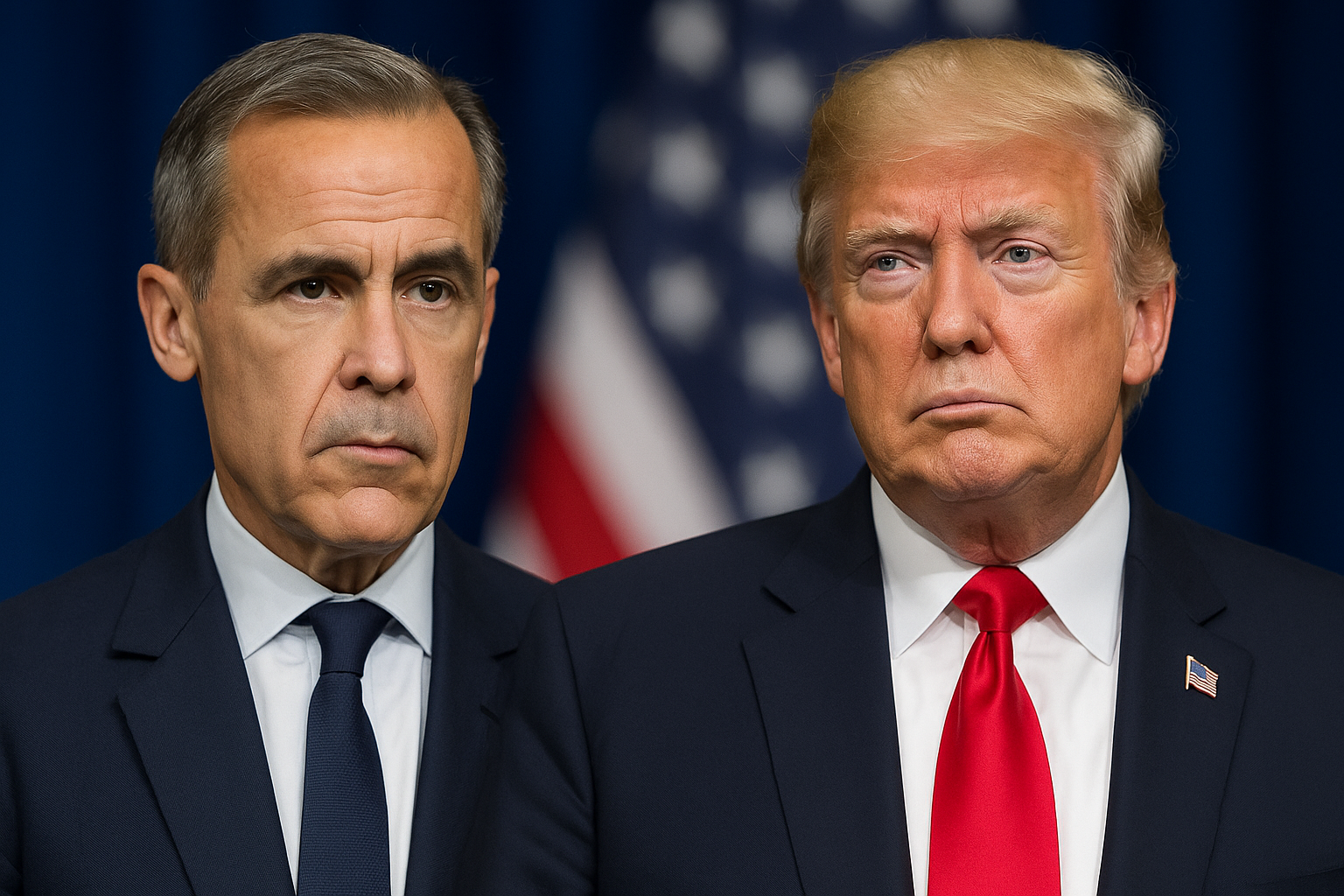
Mark Carney’s “Elbows Up” campaign, launched with the promise of boldly confronting Donald Trump and forcing the removal of unfair U.S. tariffs, has, by any realistic measure, fallen short. Rather than clearing the path for freer access to Canada’s largest trading partner, his tenure has seen tariffs persist, and in many cases, escalate, while Canada remains tethered to the very dependency he pledged to reduce.
Carney has not secured the lifting of Trump’s tariffs. On the contrary, rather than easing pressure, U.S. duties have intensified. Most recently, the U.S. ramped-up certain levies from 25% to 30%, deepening the hit on Canadian exporters. Meanwhile, softwood lumber, long a flashpoint, now faces near‑tripled anti‑dumping duties, raising combined U.S. tariffs on many Canadian timber products from roughly 14.5% to 34.5%. These harsh escalations are hardly indicative of success in slaying the tariff menace.
The Prime Ministers has acknowledged that roughly 85% of Canadian exports to the U.S. still enjoy duty‑free access under USMCA, a protection inherited from the previous trade agreement. Yet that still leaves key sectors, especially outside energy, vulnerable to punitive duties. Business‑to‑business exporters, for instance in manufacturing, chemicals, agriculture, and furniture, face disruption if they cannot meet the new USMCA content rules. 
The reality is stark: new tariffs remain, existing ones have swollen, and for many Canadian firms, especially small and medium‑sized, the barriers to accessing the U.S. market have grown, not shrunk.
Worse still, Carney’s tenure has seen little tangible progress in reducing Canada’s economic dependency on its southern neighbour. Despite widespread rhetoric on diversification, 70% of Canadian exports still go to the United States; no other partner accounts for more than 10%. From May 2024 to May 2025, export share to the U.S. declined, from $51.6 billion to $43.9 billion, a 15% drop, but though exports to rest of world rose 42%, the net result left Canada with a $2 billion shortfall.
There is growing acknowledgement, even outside Carney’s immediate orbit, that this failure to cultivate alternate markets was a glaring policy gap: one expert bluntly noted Canada “failed to cultivate new trade corridors that could have helped to mitigate the impact” of Trump’s return to power. Efforts to pivot toward Europe via CETA have made some headway, EU‑trade rose about 57% to $34 billion USD in 2024, yet remain far too modest to counterbalance U.S. reliance.
Even in sectors traditionally considered national priorities, energy and minerals, Canada’s position has barely shifted. Though the U.S. maintains exemptions for almost all energy exports, the lack of meaningful outreach to new markets, especially Asia, leaves this sector perilously one‑dimensional. Simultaneously, domestic political dynamics, particularly opposition within Carney’s governing coalition to extractive industries, have limited progress in promoting mining or energy expansion, especially for critical minerals essential to emerging industries.
Carney’s rollout of aid packages, such as the up to $1.2 billion for softwood lumber, provides short term relief, but underscores the reality that Canadian sectors are being forced into survival mode rather than thriving through unleashed opportunity.
On the political front, Carney’s much‑promised assertiveness has given way to a cautious posture. A recent poll captures the shift: when President Trump threatened 35% tariffs on all goods by August, Canadians publicly questioned whether Carney was even raising his elbows anymore. The shift from showmanship to silence is palpable.
Yet Carney has shown a willingness to negotiate cautiously, “we’ll speak when it makes sense,” as he recently put it. Canada’s Trade Minister continues to express hope for a “mutually beneficial deal”. But hope without outcomes is not influence, and while Mexico gained reprieves, Canada saw tariffs deepen. As further indication of trouble on that front, Mexico recently rejected a bilateral trade agreement with Carney’s emissaries coming back to Ottawa empty-handed.
Taken together, Carney’s record reads like diplomatic exhaustion. Promised leadership; delivered deference. Bold rhetoric; static results. The tariffs remain. Trade remains one-sided. Diversification remains a distant ambition.
Canada’s still-promised pivot toward Europe, Asia, and emerging markets now bears the burden of not just economic opportunity, but reputational salvage. Carney came to office vowing to confront American coercion with conviction. Instead, he has presided over its normalization.
In the end, historical dependencies unbroken; new challenges unaddressed; and a nation still tethered to its most fragile economic partner. The “Elbows Up” strategy hasn’t lifted tariffs, if anything, it has seen them jab deeper.