When Mark Carney took office, he brought with him the mystique of a central banker with global credentials, former Bank of Canada governor, then Bank of England governor, climate finance advocate, and World Economic Forum regular. His elevation to the Prime Minister’s Office was heralded by many as a moment where elite competence would rescue the country from populist drift. But increasingly, it appears Carney’s go-to solution for Canada’s economic challenges is neither innovation nor structural reform, but bailouts.
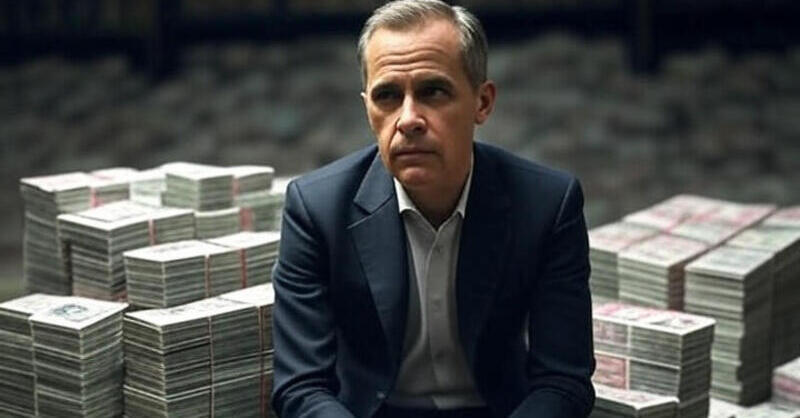
Carney may be many things, an economist, an internationalist, a technocrat, but as he rounds out his first year in office, a new label seems to be sticking: The Bailout Prime Minister.
The $1.2 Billion Band-Aid for Lumber
Let’s begin with the most recent example. Earlier this week, Carney announced a $1.2 billion aid package for Canada’s softwood lumber industry. The move comes as tensions escalate with the United States, which is reimposing steep tariffs on Canadian lumber in the latest chapter of a decades-old trade dispute. 
Carney framed the bailout as a shield for workers and a way to invest in domestic infrastructure. The government will provide loans, grants, and export support. But this is the second such support package in recent years, and nowhere in Carney’s announcement was there any discussion of how Canada might solve the structural issue at the heart of the softwood lumber conflict, namely, the pricing mechanisms of provincial timber sales, which the U.S. consistently argues amount to unfair subsidies.
Instead of negotiating a resolution or reforming outdated policy, Carney reached for the national chequebook.
A Pattern Emerges
This isn’t an isolated case. Since taking power, Carney has reached into taxpayer pockets again and again to prop up politically sensitive or strategically important industries.
- The CBC continues to enjoy hundreds of millions of dollars in public subsidy, with the Carney government adding an additional $50 million to its annual appropriation “to support modernization.” This, despite plummeting ratings, declining public trust, and a national media environment that is increasingly diverse and decentralized.
- Steel and aluminum producers have once again found themselves in the Carney government’s bailout queue. After renewed U.S. tariffs under the Trump administration 2.0, Ottawa rushed to announce a stabilization fund to “protect Canada’s industrial base.” No doubt the government will say this is about national security, but it’s also about electoral math, those industries are concentrated in vote-rich Ontario and Quebec.
- Even automotive manufacturing, which the Trudeau government lavished with EV transition money, has received additional “support” under Carney’s watch to maintain operations in light of U.S. Inflation Reduction Act headwinds.
And when inflation hit grocery aisles, the Carney Liberals threatened price controls and floated subsidies to grocers. That, too, is a bailout by another name.
Why This Should Worry Conservatives
Canadians may find themselves torn. On the one hand, no one wants to see workers thrown to the wolves in a global economy tilted by American protectionism and China’s manipulations. On the other hand, Carney’s instincts are beginning to look less like emergency responses and more like a governing philosophy.
We should be deeply concerned about the long-term implications of a government that substitutes fiscal discipline and industrial strategy with fiscal sedatives.
Bailouts are addictive. They distort markets, delay necessary reform, and signal to industries that the risk of failure has been nationalized. When the federal government consistently steps in to prop up sectors facing headwinds, it removes the incentive for innovation, competitiveness, or even basic efficiency. Corporate leaders begin managing not for the market, but for the next press conference in Ottawa.
Worse still, it reinforces a central-planning mindset among Liberals that positions Ottawa as the indispensable hand in every economic decision. This runs counter to the very Canadian tradition of enterprise, self-reliance, and regional economic dynamism.
From Monetary Policy to Fiscal Activism
There’s also an irony worth noting. Carney made his name in monetary policy circles, credited by progressives for stabilizing the UK economy post-2008 and for helping to steer Canada through the global financial crisis. Yet as Prime Minister, he has pivoted hard into fiscal activism, channeling more Trudeau than Thatcher.
And it’s not hard to see why. Bailouts are good politics, at least in the short term. They allow the government to stage photo ops with hard-hatted workers and sympathetic CEOs. They shift the narrative from crisis to action. They’re even easier to justify when the villain is a foreign government, especially one led by Donald Trump.
But fiscal activism has a cost. Canada’s debt is already approaching $1.4 trillion. Interest payments are crowding out spending on core services. And as demographics shift, the fiscal room for further interventions will narrow. Carney’s response? Borrow and spend.
The Missed Opportunity
What Canada needs is not another injection of borrowed money, but a reset in how we compete. We need to renegotiate trade terms with a United States that is increasingly hostile to rules-based commerce. We need to reform internal trade barriers that make it harder to move goods within Canada than across the U.S. border. We need to cut red tape, lower business taxes, and unlock capital for the next generation of entrepreneurs.
Carney, with his connections and credentials, is supposed to be positioned to sell Canada as a reliable economic partner and investment destination. Instead, he seems more comfortable managing decline than engineering growth.
A Risk-Adverse Technocrat, Not a Bold Reformer
Ultimately, Mark Carney is governing like the economist he is, incrementally, risk-averse, and heavily reliant on top-down controls. In an increasingly volatile world, that might look like prudence. But in practice, it’s starting to look like inertia.
We are watching an economic strategy unfold that is reactive, not proactive. Bailouts are easy. Reform is hard. And until this government chooses the latter, we will keep papering over our problems with taxpayer dollars.
In that light, the title sticks.
Mark Carney is not the Prime Minister of Prosperity. He is the Prime Minister of Bailouts.