
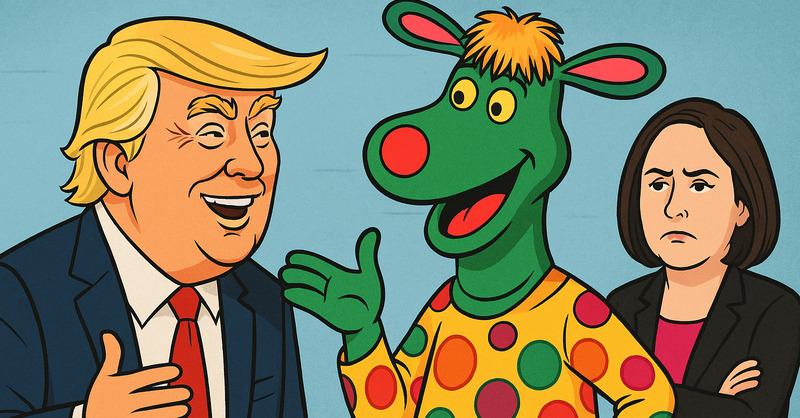
In Washington, Donald Trump’s effort to strip public funding from PBS and NPR was treated by the cultural left as an act of vandalism. Yet, in reality, it was a long-overdue push toward a healthier, more accountable model for public broadcasting, one rooted in voluntary support rather than compulsory taxation. Canada, still saddled with a bloated and ideologically rigid CBC, and provincially with outlets like TVO, could learn much from this example.
Trump’s move was not about silencing voices. PBS and NPR are still on the air; they still produce news, documentaries, and cultural programming. What has changed is that they must now increasingly earn their keep through voluntary contributions, sponsorships, and partnerships. That is an honest market test of whether an audience truly values their product. It removes the guaranteed taxpayer backstop that allows public broadcasters to drift away from their founding mandates and into the comfort zone of politically and culturally uniform content.
Here in Canada, the CBC is an object lesson in why such reform is necessary. Founded with the mission of telling Canadian stories to Canadians, it was meant to unify a vast, geographically scattered country, fill coverage gaps in remote areas, and ensure Canadian culture could compete with the powerful influence of American media. That was in the age of shortwave, before cable, satellite, and the internet. In 2025, none of those original conditions exist in the same way. Technology, private media, and the explosion of choice have changed the environment completely. But CBC has not adapted, it has entrenched itself as an opinion-shaping machine for the urban cultural left. 
The CBC’s programming is now defined less by a commitment to balanced journalism and more by a curatorial mindset steeped in progressive orthodoxy. Its editorial lens is consistently collectivist: favouring state intervention, climate alarmism without dissent, identity politics, and a cultural narrative that treats skepticism of these positions as fringe or dangerous. This is not serving Canadians, it is serving a political and cultural project. For taxpayers who do not share these values, funding the CBC feels like subsidizing an institution that does not see them as part of the audience it serves.
The left will resist reform ferociously. In Canada, this resistance will be louder and more sanctimonious than what Trump faced in the United States. Expect an endless parade of op-eds warning of the “death of Canadian culture” and “loss of our national voice.” Expect fearmongering about how private media is “beholden to corporate interests” while public broadcasting is “independent.” These arguments ignore the obvious: public broadcasting is not independent, it is beholden to the worldview of the political and bureaucratic class that funds it. In practice, this means the worldview of the Laurentian progressive establishment.
What makes the PBS/NPR case so instructive is that these outlets were not abolished, they were nudged toward a consent-based model. This is crucial. Critics of reform in Canada will attempt to frame any reduction in public funding as an attempt to “shut down” CBC. That is not the point. The point is to make them answer the same question every private media outlet must face: “Do enough people value what we produce to sustain it voluntarily?”
Trump’s approach in the U.S. didn’t make PBS and NPR vanish; it forced them to respect their audience. They now lean more heavily on pledge drives, donor clubs, and partnerships. Yes, the tone of their programming still often reflects a progressive bias, but now that bias must compete in the open market of voluntary funding. If the audience likes it, they will pay for it. If they do not, the outlets will have to change or contract. That is a self-correcting mechanism, one entirely absent from the Canadian model.
In Canada, the CBC receives well over a billion dollars annually from taxpayers, regardless of audience size or public trust. This is not a “safety net”, it is a blank cheque. It allows the corporation to alienate large segments of the population without consequence, since the people paying for it have no option to withdraw their support. This arrangement is more fitting for a propaganda bureau than a public broadcaster.
A voluntary funding model would transform the relationship between CBC/TVO and the Canadian public. For the first time, these institutions would have to treat the audience as customers, not as a captive market. They would have to broaden their appeal beyond a narrow ideological base. They would have to program for all Canadians, not just for progressive elites in Toronto, Ottawa, and Vancouver.
The cultural left in Canada will claim this is “Americanizing” our media system, as if that is inherently bad. Yet, when the United States moves toward a model where public broadcasters must earn their audience’s consent, that is an act of democratic respect. Canadians should welcome it. It means a broadcaster survives because it has persuaded its viewers and listeners of its value, not because Parliament has imposed a tax to keep it alive.
The necessity of reform becomes clearer when you look at what CBC is today. It is no longer a mere broadcaster; it is a competitor in the digital ad market, using taxpayer money to undercut private outlets. Its online content is indistinguishable from that of other media players, except that CBC does not have to worry about profitability. This distorts the media ecosystem, driving clicks and ad revenue away from smaller, independent voices. In effect, taxpayers are funding a monopoly player that crowds out diversity of thought.
For rural and remote communities, where CBC still claims to serve a unique role, the 21st century offers countless private-sector alternatives: satellite radio, streaming news services, YouTube, podcasts, and community-run outlets. None require a billion-dollar national bureaucracy to function. CBC’s justification for public subsidy is, in practice, nostalgia.
The question is not whether Canadians should have access to Canadian programming, they should. The question is whether this programming should be financed by coercion or by consent. The PBS/NPR example shows that voluntary funding is possible, and that quality content will survive if it truly has an audience.
For too long, CBC has been insulated from reality. It has grown comfortable ignoring half the country. Its programming choices and editorial biases reflect the tastes and priorities of a cultural class that assumes its own worldview is universal. This is why left-leaning Canadians will view any call for reform as an existential threat, it is not just about budgets, it is about their cultural dominance.
But reform is not about silencing; it is about accountability. It is about ending the practice of forcing taxpayers to bankroll a broadcaster that actively marginalizes their views. It is about creating a healthier media environment where public outlets must earn trust rather than presume it.
The United States has shown that change is possible. Canadians should seize this moment to ask why their public broadcasters are immune to the pressures and accountability that every other media outlet faces. A consent-based funding model would not kill CBC or TVO, it would make them better. It would make them more representative, more responsive, and more respectful of the public they claim to serve.
If Canadians want broadcasters that truly reflect the breadth of this country’s views and experiences, then they must stop paying for ideological echo chambers. Let CBC and TVO stand on their own two feet. If they succeed, it will be because Canadians, voluntarily, decided they were worth it. If they fail, it will be because Canadians decided they were not. Either way, the decision should rest with the people, not with the state.